A pioneer of probiotics for women’s health

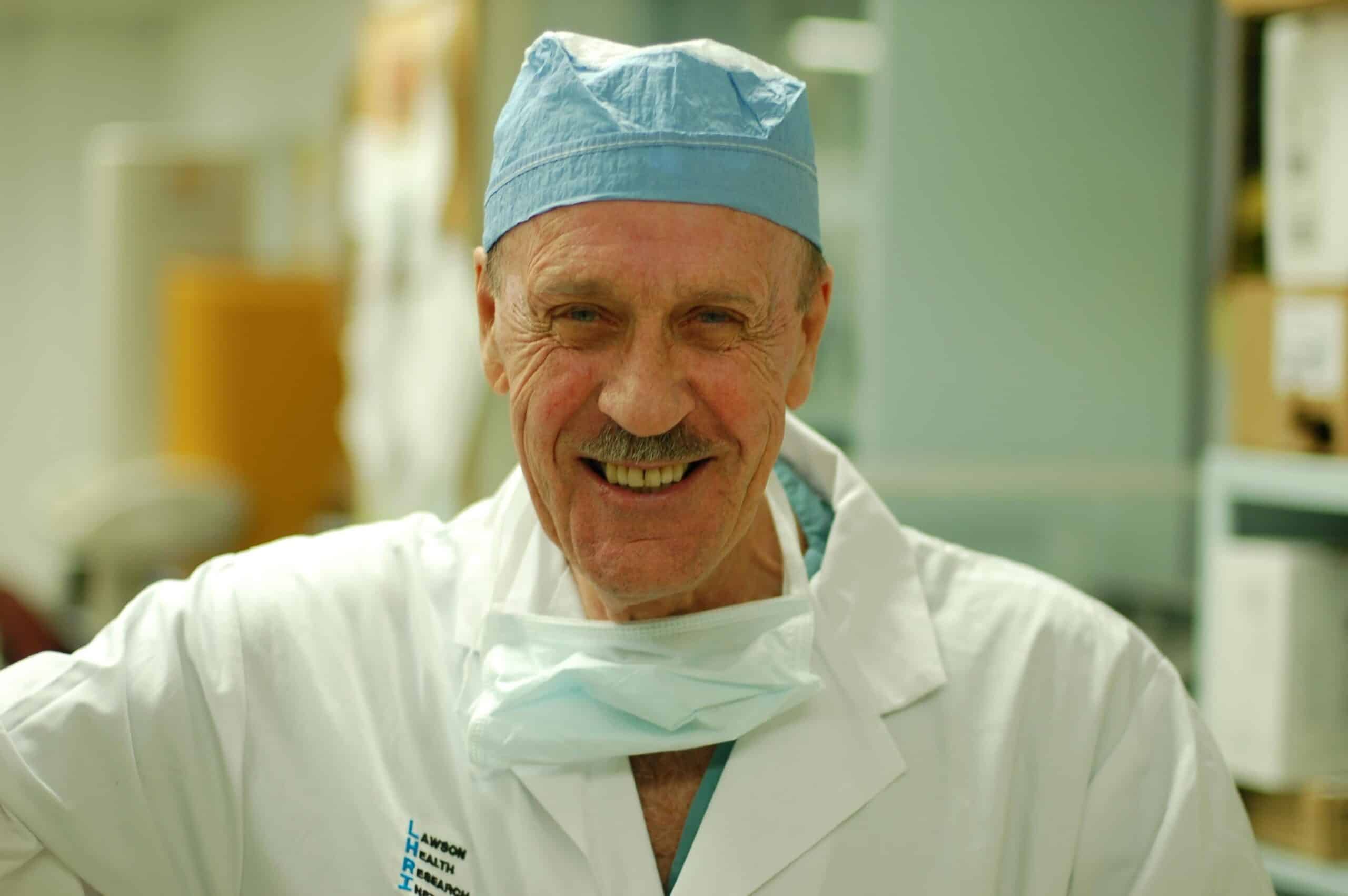
A tribute by Dr. Gregor Reid to the life’s work of Dr. Andrew Watt Bruce
On 18th June 2026, physician and probiotics researcher Dr. Andrew Watt Bruce MB ChB, FRCS passed away at age 101. Until the very end, his mind was sharp and his love of probiotic research remained strong.
Since ISAPP’s founding in 2002, I have seen many important contributions to the research made by physicians and surgeons. Some of those contributions were made by current and past ISAPP Board members, and others were made by people who helped and inspired the board members. I wanted to write a short eulogy for this special surgeon who started as my boss, became my mentor and then with his wife Margaret became a wonderful part of our family.
Dr. Bruce was a pioneering Canadian urologist, originally from Aberdeen Scotland. His stellar career and massive contributions to urology have been rightly documented elsewhere. One memorable contribution, interestingly using bacteria, was publishing the first paper showing the effectiveness of the live vaccine BCG for non-muscle invasive bladder cancer, a highly effective treatment that today remains the regulatory and clinical-trial benchmark and one of the most cited contributions to the management of human cancer. Arguably, there is no other cancer drug that has achieved this status as a single agent. Millions of patients around the world have benefited from this discovery.
However, it was Dr. Bruce’s 1974 paper (1) suggesting that lactobacilli in the perineum may be protecting women from urinary tract infection (UTI) that led to his pursuit of probiotic applications for women. This was a pivotal moment as it recognized the importance of the female urogenital microbiome and suggested there could be a role for probiotics to help prevent and treat infections.
By the time I met him in 1982, fresh from my PhD on uropathogenic E. coli causing UTI, he had moved from Queen’s University to McGill then Toronto, having isolated a number of lactobacilli strains from the vagina, perineum and urethra of healthy women. Working with fellow scientists Raphael Chan and Roger Cook, we identified Lactobacillus strains GR-1 and RC-14 and others and detailed the properties that made them work against uropathogenic bacteria and fungi. The outcomes of that work have been published in many papers and books.
What was so stimulating about partnering with Dr. Bruce, sometimes in the operating room discussing research as he performed surgery, was his enthusiasm and commitment to excellence. I saw it as he visited his patients, post-surgery. I saw it as he improved my slide presentations, grant writing and manuscripts. I saw it at Urology Rounds when he displayed a remarkable photographic memory for the literature and for not letting residents cut corners. At times, he was like the TV character ‘House’, looking at cases from all directions.
Today, there are incredible physicians who understand the complexities of molecular biology, CRISPR technology, microbial sequencing and bioinformatics. Young scientists can learn so much from their clinical insights. Those methods had not been discovered when Dr. Bruce and I worked together, but he understood the science, and taught me the importance of clinical information, including how each patient felt. That allowed me to ‘picture’ the real issues and think of ways in which probiotic organisms might alleviate pain. It also taught me the importance of each individual case. I appreciate that meta-analyses and numbers-needed-to-treat are critical factors in assessing treatments, but sometimes a single case can provide valuable information, as well as illustrating the empathy we as scientists should bring to our discipline.
For today’s students who can’t imagine that we used landline telephones at home and wrote actual letters to journals, it will be hard to appreciate some of the ridicules we faced in proposing that administering live microbes to humans could prevent or treat disease. One doctor laughingly asked what flavor of yogurt we would insert into the vagina to prevent UTI. Scientists on grants panels repeatedly brushed our work aside saying we had antibiotics so why would we need probiotics? Rather than give up, Dr. Bruce believed in the concept we were pursuing and acquired funds from various sources to help us continue the research.
We decided to file patents so that the ideas could be protected. That proved helpful when we met two investors in the late 1980s who wanted to take the concept to the Nasdaq Junior market. They said we’d make a fortune through marketing and storytelling. We told them we couldn’t do that without more proof that the concept actually helped women. Having Dr. Bruce’s stature behind us was important in telling them ‘no’ and continuing our clinical and lab research.
In the end, the human trials we performed used a formulation produced by the leading manufacturer of probiotic strains, at that time, and any thoughts of making the strains available for women was built upon holding on to our ethical principles. Today, we are humbled knowing that the strains contribute to the health of women around the world. It was fitting that world-renowned Stanford Professor of Surgery Tom Stamey wrote to Andrew in 1990, “I have long admired your careful, thoughtful and scholarly research which has been absolutely outstanding.”
In the past ten years, Andrew was excited to see a number of probiotic strains documented for vaginal and bladder health. He was encouraged that the urogenital tract now forms a critical component of the microbiome field where microbes are applied to counter disease and maintain health. For any woman who has suffered from UTI or related bladder or kidney diseases, we can at least tell them that hope is on the horizon, when for decades their only option was broad spectrum antimicrobials and the dread of recurring episodes that impacted their quality of life.
Having taught medical and dental students during my career, it always saddened me when professors emphasized the monetary gains rather than how students could advance their field through medical science. On the contrary, Dr. Bruce was a dynamic teacher who emphasized the need to do the very best for each patient and to bring the latest technologies to their care. Four of his trainees became department chairs and many of his students have gone on to stellar careers. In the final years of his life, he continued to search for the latest breakthroughs in medicine for friends who sought his counsel. Quite remarkable!
Andrew and his wife Margaret, who became a mother-like figure to me, established a Visiting Professorship at Queen’s University in Canada not only to bring the brightest minds to campus but also to challenge them to collaborate with local surgeons and scientists to develop breakthroughs in diagnosis and treatment. That summed up Andrew’s message; be proactive and always look to make things better than when you found them.
Andrew attended an early ISAPP meeting but in case he is not known to many current participants, I hope this short reflection on his career helps to place his legacy in perpetuity and encourages young scientists to work with clinical colleagues. We should treasure the pioneers, learn from their journeys and continue to drive forward for the benefit of others.
The current generation has the tools to succeed. Let’s hope that one day, someone will write about their achievements and inspire others in the ‘biotics field.
Gregor Reid PhD MBA FRSC Past President, ISAPP
REFERENCES: